


Abstract
Purple Urine Bag Syndrome (PUBS) is a rare but visually striking phenomenon usually seen in elderly, immobile, and chronically catheterized patients. Although it usually follows a benign course, its alarming appearance may trigger excessive diagnostic and therapeutic interventions, leading to unnecessary increases in healthcare utilization. We report the case of a 95-year-old woman with chronic ischemic heart disease, followed through home healthcare services, who developed PUBS without clinical or laboratory evidence of infection. The condition resolved completely after simple catheter and bag replacement, without antibiotic therapy. This case emphasizes that PUBS does not always indicate active infection and highlights the importance of rational management in primary care and home healthcare practice, preventing overdiagnosis, overtreatment, and unnecessary antibiotic use.
Keywords: aged, home care services, primary health care, purple urine bag syndrome, urinary catheters
Introduction
Purple Urine Bag Syndrome (PUBS) is a rare but clinically striking condition characterized by purple discoloration of the urinary catheter and urine collection bag. First described in 1978, the syndrome has been associated with several risk factors, including alkaline urine pH, low fluid intake, immobility, long-term catheterization, chronic constipation, advanced age, and female sex.[1] The fundamental mechanism in the pathogenesis begins with the metabolism of tryptophan by gastrointestinal flora, followed by its absorption into the portal circulation.[2] In the liver, indole undergoes conjugation processes and is converted into indoxyl sulfate, which is excreted in the urine. Indoxyl sulfate is then hydrolyzed to indoxyl by the enzyme indoxyl sulfatase produced by certain bacteria in the urinary tract. In an alkaline urine environment, indoxyl is oxidized to indigo (blue) and indirubin (red) pigments. The interaction of these pigments with the plastic surface of the urine bag results in the characteristic purple discoloration.[2,3]
The microorganisms most frequently implicated include Pseudomonas aeruginosa, Proteus mirabilis, Providencia species, Klebsiella pneumoniae, Escherichia coli, Morganella morganii, Citrobacter species, methicillin-resistant Staphylococcus aureus, group B streptococci, Enterobacter and Enterococcus species.[4,5] However, in some cases, urine cultures reveal no bacterial growth, and the clinical course may remain completely asymptomatic.
Although PUBS is generally benign, its striking appearance may cause considerable anxiety for both patients and caregivers. It may be encountered particularly in elderly individuals undergoing long-term catheterization and followed either in primary care settings or within the scope of home healthcare services. Recognition of the syndrome not only helps to alleviate unnecessary concerns but also prevents overdiagnosis, redundant diagnostic procedures, and inappropriate therapeutic interventions, thereby supporting evidence-based and rational patient management.
Case Presentation
A 95-year-old female patient with chronic ischemic heart disease, who had been followed by home healthcare services with a long-term indwelling silicone Foley catheter for approximately six months, was evaluated after purple discoloration of the urine bag was observed during a routine catheter replacement (Figure 1). The catheter was routinely replaced every 28 days as part of her home healthcare follow-up, and the current catheter had been in place for approximately 28 days before replacement. According to her caregivers, the purple discoloration had first appeared two days before the visit, and they planned to report this finding during the scheduled catheter replacement because the routine home healthcare visit was imminent. The patient’s general condition was good; she was conscious, oriented, and cooperative, with no urinary system symptoms. Other than her regular medications for chronic ischemic heart disease, there were no recent changes in pharmacological therapy, and caregivers did not report significant constipation.
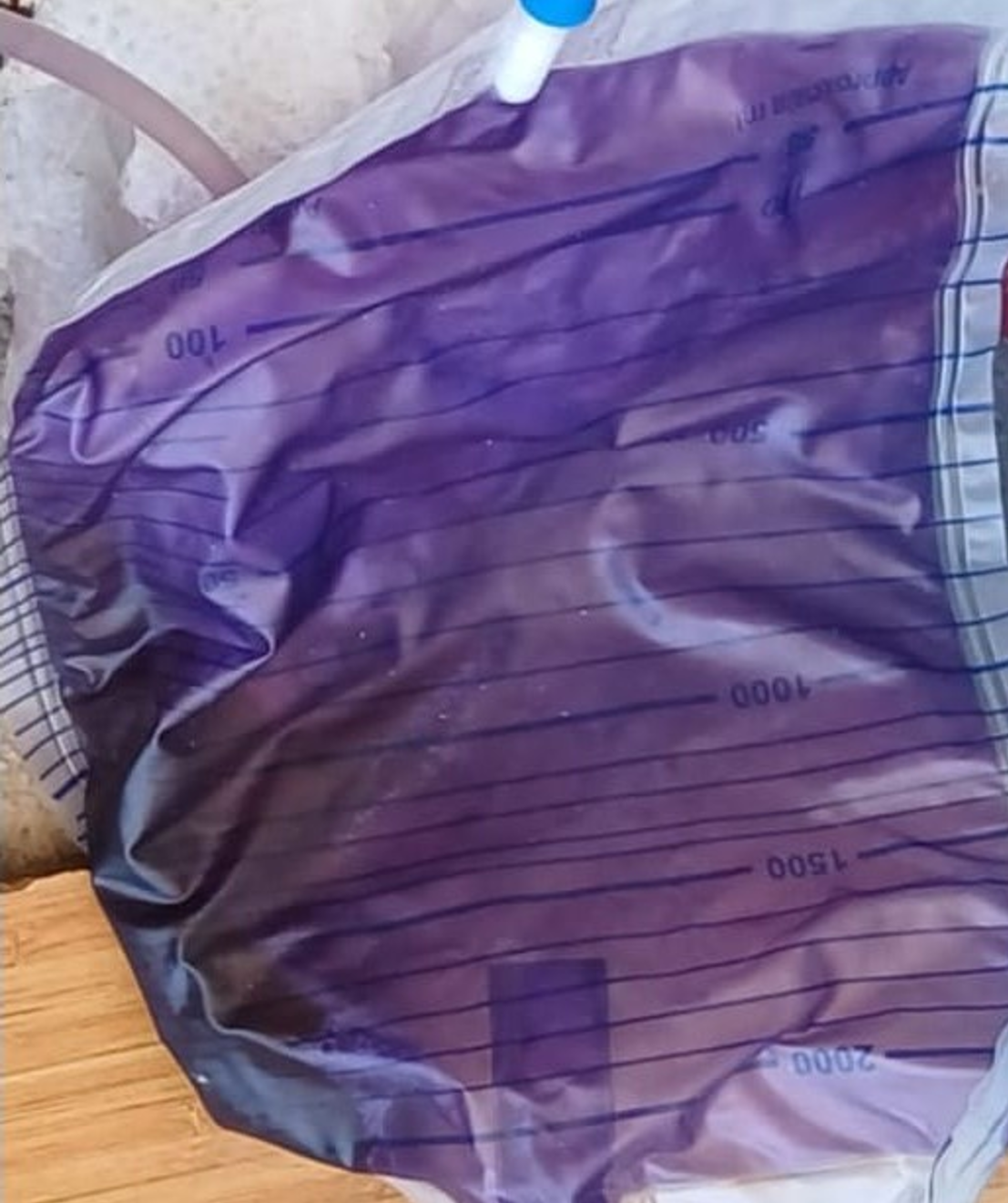
On physical examination, her temperature was 36 °C, pulse 99/min, and blood pressure 100/65 mmHg. Abdominal examination revealed no guarding or rebound tenderness. There were no signs of erythema, discharge, or irritation at the catheter insertion site. The urinary catheter and bag were replaced, and the newly drained urine appeared normal in color. Blood tests, urinalysis, and urine culture were obtained.
Laboratory analysis revealed a urine pH of 7.2, negative nitrite and leukocyte esterase, 4–5 leukocytes/hpf, and 10 erythrocytes/hpf. Blood tests showed a white blood cell count within normal limits, hemoglobin consistent with chronic anemia at 10.2 g/dL, AST 18 U/L, ALT 10 U/L, urea 45 mg/dL, creatinine 1.12 mg/dL, and CRP 0.78 mg/L. In the absence of infection markers and given the normalization of urine color after catheter replacement, antibiotic therapy was not initiated, and the culture result was awaited. The urine culture later revealed growth of Enterobacter cloacae.
After catheter and urine bag replacement, the newly inserted urine bag did not show recurrent purple discoloration. The patient remained clinically stable, afebrile, and asymptomatic, and no urinary tract infection symptoms developed despite the absence of antibiotic therapy. At the one-month follow-up, no recurrence of purple discoloration or urinary tract infection symptoms was observed.
Written informed consent for publication was obtained from the patient’s legal guardian.
Discussion
Purple Urine Bag Syndrome (PUBS), although rare, has been reported particularly in elderly patients with long-term catheterization. The literature emphasizes that PUBS is generally benign in nature and is most often detected incidentally.[3] However, the striking appearance of the syndrome may cause considerable anxiety for both patients and caregivers. PUBS can be explained by a triadic interaction between host-related factors such as advanced age and immobility, microbial factors involving indole-producing microorganisms, and device-related factors related to prolonged pigment exposure on plastic catheter and urine bag surfaces. Accordingly, PUBS should be considered not merely an infectious condition but a biochemical phenomenon occurring in susceptible hosts with urinary devices.
Most cases reported in the literature occur in elderly, female, and immobile patients.[2,5] Systematic reviews demonstrate that 61.29% of cases involve women and 38.71% involve men, with a predominance in advanced age groups and frequent coexistence of comorbidities such as diabetes mellitus and hypertension.[6] Similarly, our case developed in an elderly female patient with long-term bladder catheterization. However, the distinctive feature of this case is the complete resolution of the clinical presentation solely with catheter and urine bag replacement, without any systemic signs of infection. Indeed, the literature highlights that antibiotic therapy is not required in asymptomatic PUBS cases and is indicated only in the presence of symptomatic urinary tract infection.[7]
According to guidelines published by the Infectious Diseases Society of America (IDSA), antimicrobial treatment is not recommended when bacteriuria is present in the absence of clinical symptoms[8] As demonstrated in this case, withholding antibiotics in asymptomatic patients not only prevents unnecessary antimicrobial use but also reduces the risk of antimicrobial resistance. Furthermore, it avoids additional morbidities that may arise from antibiotic therapy in elderly and comorbid individuals. This underscores the importance of a rational management approach, particularly in the care of elderly and catheterized patients frequently encountered within home healthcare services. This rational approach additionally helps to reduce the burden of advanced diagnostic testing, thereby improving the effectiveness of patient management in the primary care setting.
In the present case, the urine pH was 7.2, indicating a mildly alkaline environment and remaining lower than the markedly alkaline pH levels classically associated with PUBS. The fact that PUBS cases have also been reported in acidic or near-neutral urine suggests that pigment formation may not depend solely on urinary pH.[9] Additional mechanisms, including local microenvironmental factors, bacterial enzymatic activity, the duration of contact between pigments and the catheter bag surface, and oxidation processes, may also contribute to the development of this condition.
The main contribution of this case is not to present PUBS as a novel clinical condition, but to demonstrate that an asymptomatic PUBS episode developing in an elderly patient with chronic catheterization followed through home healthcare services can be successfully managed with catheter and urine bag replacement alone, despite a positive urine culture and in the absence of clinical and laboratory findings of urinary tract infection. Home healthcare services represent an important care setting in which patients with major risk factors for PUBS, such as advanced age, immobility, and long-term urinary catheterization, are closely monitored. Therefore, accurate recognition of PUBS by home healthcare teams may contribute to the prevention of unnecessary diagnostic escalation, inappropriate antibiotic use, and avoidable hospital referrals in asymptomatic cases.
Conclusion
This case demonstrates that in asymptomatic Purple Urine Bag Syndrome, catheter replacement alone may be sufficient and that antibiotic therapy is not always required. Awareness of this condition in family medicine and home healthcare practice contributes to patient safety, reduction of antimicrobial resistance, and prevention of unnecessary polypharmacy in vulnerable elderly populations.
Limitations of the case
This case has several limitations. Serum indoxyl sulfate levels, urine pigment characterization, and spectrophotometric analysis were not performed because these tests are not part of routine home healthcare or primary care practice. In addition, detailed microbiological assessment of bacterial enzymatic activity was not available. Nevertheless, the clinical presentation, characteristic discoloration of the urine bag, absence of systemic infection findings, and complete resolution after catheter and bag replacement support the diagnosis of PUBS.
Patient consent
Written informed consent for publication was obtained from the patient’s legal guardian.
Ethical approval
Ethics committee approval was not required for this case report. Written informed consent was obtained from the patient for publication.
Source of funding
The authors declare the study received no funding.
Conflict of interest
The authors declare that there is no conflict of interest to disclose.
References
- Mızrak M, Yetkin Mızrak Ö, Çelikbilek N, Başar E, Kocaağa M. Purple urine bag syndrome: a rare clinical case. Mikrobiyol Bul. 2019;53(4):457-463. https://doi.org/10.5578/mb.68616
- Al Montasir A, Al Mustaque A. Purple urine bag syndrome. J Family Med Prim Care. 2013;2(1):104-105. https://doi.org/10.4103/2249-4863.109970
- Traynor BP, Pomeroy E, Niall D. Purple urine bag syndrome: a case report and review of the literature. Oxf Med Case Reports. 2017;2017(11):omx059. https://doi.org/10.1093/omcr/omx059
- Koyuncu S, Keklik HN, Biçer NS. Purple urine bag syndrome. Journal of Anatolian Medical Research. 2024;9(3):121-123. https://doi.org/10.55694/jamer.1486403
- Mantani N, Ochiai H, Imanishi N, Kogure T, Terasawa K, Tamura J. A case-control study of purple urine bag syndrome in geriatric wards. J Infect Chemother. 2003;9(1):53-57. https://doi.org/10.1007/s10156-002-0210-x
- Basehi MF, Dallak FH, Darraj AI, Almalki SJ. Purple urine bag syndrome: an unusual presentation of urinary tract infection: a case series and literature review. Medicine (Baltimore). 2025;104(38):e44638. https://doi.org/10.1097/MD.0000000000044638
- Khan F, Chaudhry MA, Qureshi N, Cowley B. Purple urine bag syndrome: an alarming hue? A brief review of the literature. Int J Nephrol. 2011;2011:419213. https://doi.org/10.4061/2011/419213
- IDSA. Asymptomatic bacteriuria. Available at: https://www.idsociety.org/practice-guideline/asymptomatic-bacteriuria/ (Accessed on 3 May, 2026).
- Katyal A, Menon AS. Purple urine bag syndrome in acidic urine! Amrita Journal of Medicine. 2021;17(4):146. https://doi.org/10.4103/AMJM.AMJM_42_21
Copyright and license
Copyright © 2026 The Author(s). This is an open access article distributed under the Creative Commons Attribution License (CC BY), which permits unrestricted use, distribution, and reproduction in any medium or format, provided the original work is properly cited.