


Abstract
Objective: Although folate status has been widely studied, few studies have simultaneously evaluated multiple demographic, behavioral, and clinical factors in a single primary care population. This study aimed to determine the prevalence of folate insufficiency and evaluate the factors associated with this condition using routinely collected primary care data.
Methods: This retrospective cross-sectional study used electronic health records from adults registered at the Uludağ University Family Health Center who underwent serum folate measurement between January 1, 2020, and December 31, 2024. All eligible individuals with complete data were included in the final analysis (n = 995). Statistical analyses were performed using IBM SPSS Statistics version 28.00. A two-sided p-value of <0.05 was considered statistically significant.
Results: Of the 995 participants, 293 (29.4%) were male, and 702 (70.6%) were female; the mean age was 30.23 ± 12.92 years. Serum folate testing revealed insufficiency in 185 (18.6%) participants. In the multivariable model conducted among female participants, pregnancy complications (adjusted OR = 2.49, 95% CI: 1.34–3.60), allergic diseases (adjusted OR = 2.29, 95% CI: 1.19–3.31), genetic diseases (adjusted OR = 2.25, 95% CI: 1.29–3.54), cancer (adjusted OR = 1.81, 95% CI: 1.16–2.72), and non-pregnant status (adjusted OR = 1.70, 95% CI: 1.11–2.32) were independently associated with folate insufficiency.
Conclusion: Pregnancy complications, allergic diseases, genetic diseases, and cancer were associated with higher odds of folate insufficiency, whereas pregnant participants had lower odds than non-pregnant participants. The association with pregnancy status should be interpreted cautiously because data on folic acid supplementation and antenatal follow-up were unavailable. Family physicians should consider targeted folate assessment in patients with pregnancy complications and in individuals with relevant inflammatory, genetic, or oncological conditions.
Keywords: Folic acid, folate insufficiency, primary care
Introduction
Folic acid is a water-soluble B vitamin (vitamin B9) essential for DNA synthesis and cellular division. Folic acid, also known as folate or vitamin B9, is a member of the B vitamin family and is a necessary cofactor for enzymes involved in DNA and RNA synthesis. More specifically, folic acid is required by the body for the synthesis of purines, pyrimidines, and methionine before they are incorporated into DNA or protein. Folic acid is particularly important during phases of rapid cell division such as infancy, pregnancy, and erythropoiesis, and is a protective factor in cancer development. Because humans cannot synthesize folic acid endogenously, dietary supplementation is necessary to prevent deficiencies. Folic acid is found in green vegetables, beans, avocados, and some fruits. A supplementation of 1–5 mg of folic acid is recommended to prevent deficiency and a range of side effects associated with methotrexate (MTX) treatment, including mouth ulcers and gastrointestinal irritation. Folic acid is often prescribed as a supplement to individuals using these medications. Inadequate folate levels, particularly in women of childbearing age, can lead to a variety of health problems, including cardiovascular disease, megaloblastic anemia, cognitive impairments, and neural tube defects (NTDs). Folic acid is typically supplemented during pregnancy to prevent the development of NTDs and in people with alcoholism to prevent the development of neurological disorders.[1] Folic acid is a functional food ingredient.[2] Enriching the diet with folic acid is effective in reducing birth defects.[3] It is neuroprotective, particularly in preventing neural tube defects and congenital anomalies. It has a positive effect on cancer cells.[4-7]
In 2016, the World Health Organization published the “Comprehensive Antenatal Care (ANC) Guideline” as part of its recommendations to improve routine antenatal services and support a positive pregnancy experience.[8]
Folic acid testing is performed in family medicine during general care and routine checkups. Diseases that cause folic acid insufficiency and other contributing factors should be identified, ensuring identified. Ensuring early diagnosis and treatment during the primary care process. A holistic approach that encompasses comprehensive and continuous care is crucial for preventing the consequences and complications of folic acid insufficiency. Although the prevalence and clinical consequences of low folate status are well documented, few studies have simultaneously evaluated demographic, behavioral, pregnancy-related, and clinical factors in a single primary care population using routine electronic health records. Addressing this gap may help family physicians identify patient groups who could benefit from targeted assessment and preventive care.
We hypothesized, based on previous evidence, that folate insufficiency would be associated with demographic characteristics, lifestyle behaviors, pregnancy-related factors, and chronic clinical conditions among individuals attending a primary care family health center.
Materials and Methods
The primary objective of this study was to determine the prevalence of serum folate insufficiency and investigate its variation according to demographic, behavioral, pregnancy-related, and clinical characteristics among adults attending a family health center. The main research topic of this study can be described as determining the folic acid levels of individuals and investigating how folic acid levels differ according to individual characteristics. In this context, demographic characteristics, clinical conditions, biochemical measurements, and folic acid measurement data of patients who applied to the health center were obtained from records.
Descriptive analyses were performed to summarize the demographic, clinical, and laboratory characteristics of the study population. Continuous variables were presented as mean ± standard deviation, whereas categorical variables were summarized as frequencies and percentages.
Serum folate values were not evaluated as continuous variables in the primary analysis; participants were classified as having or not having folate insufficiency according to the prespecified cutoff value. In summary, the study groups were examined with and without folic acid insufficiency. The study period included the COVID-19 pandemic, and the study population had a higher proportion of female participants. These sample characteristics were considered when interpreting the findings.
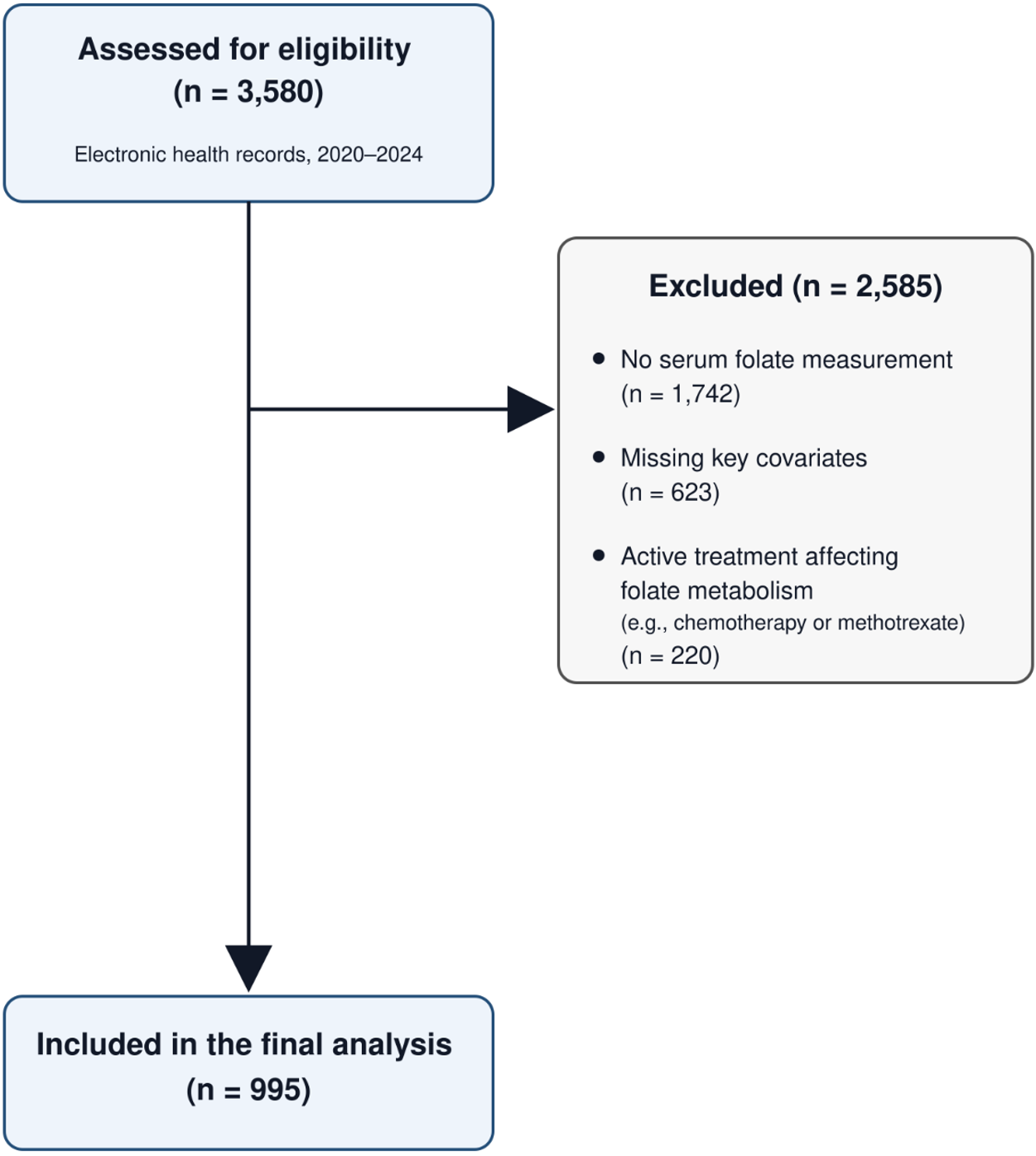
Of the 3.580 individuals initially screened, we excluded patients with missing folate measurements or incomplete key variables. The final complete-case analysis included all eligible patients with complete data (n = 995). Multiple imputation was not performed because the proportion of missing data was low and the dataset was retrospective.
Laboratory measurements
Obesity was defined as a body mass index ≥30 kg/m². Chronic disease was defined as at least one active chronic diagnosis documented in the electronic problem list or longitudinal clinical record. Allergic disease was defined as a documented allergic or atopic condition. Genetic disease was defined as a documented hereditary chromosomal or congenital genetic disorder. Pregnancy complications were defined as complications documented during the index pregnancy. Smoking and alcohol variables reflected current use documented at the index assessment. Because detailed diagnostic subcategories were not consistently available in the extracted electronic records, allergic diseases, genetic diseases, cancer, and pregnancy complications were evaluated as broad clinical categories.
Inclusion and exclusion criteria
Inclusion and exclusion criteria: Inclusion criteria comprised individuals aged ≥18 years who had at least one recorded serum folate measurement during the study period. Individuals receiving active treatments known to directly affect folate metabolism (e.g., methotrexate, chemotherapy, or radiotherapy) were excluded. Chronic conditions such as hypertension, diabetes, allergic diseases, and cancer were not exclusion criteria, as these were evaluated as exposure variables within the analysis framework.
Study design and participants
This retrospective cross-sectional study used routinely collected electronic health record data from individuals registered at the Uludağ University Family Health Center. We evaluated adults who underwent serum folate measurement between January 1, 2020, and December 31, 2024. The minimum sample size was calculated as 385 participants using a 95% confidence level and a 5% margin of error. No random subsampling was performed. Instead, all eligible individuals with complete records during the study period were consecutively included in the final analysis. Therefore, the final sample of 995 participants exceeded the calculated minimum sample size because the complete eligible sample was retained.
Statistical analysis
Statistical analyses were performed using SPSS version 28.00 (IBM Corp., Armonk, NY, USA). Numerical data were coded and entered into the statistical software for analysis. Descriptive statistics were presented as mean ± standard deviation for continuous variables and frequency (percentage) for categorical variables.
The normality of continuous variables was assessed using the Shapiro–Wilk test. Although minor deviations from normality were observed for some variables, the large sample size (n = 995) supported the use of parametric tests, based on the central limit theorem. Independent-samples t-tests were used for continuous group comparisons. Categorical variables were compared using the chi-square test or Fisher’s exact test, as appropriate.
To control for multiple comparisons, we applied the Benjamini–Hochberg false discovery rate correction. Variables included in the multivariable logistic regression model were determined based on clinical relevance and prior evidence rather than solely on univariate statistical significance.
Candidate variables for the multivariable logistic regression analysis were age, education, smoking, alcohol use, obesity, chronic disease, allergic disease, genetic disease, cancer, pregnancy status, and pregnancy complications. Variables were considered based on prior biological plausibility and clinical relevance in addition to the findings of univariate analyses. Pregnancy-related variables were evaluated only among female participants. Results were reported as adjusted odds ratios with 95% confidence intervals. These included (i) modeling serum folate as a continuous outcome using linear regression, (ii) excluding rare conditions such as cancer and genetic diseases, and (iii) estimating E-values to assess the potential impact of unmeasured confounding. Results were expressed as odds ratios (OR) with 95% confidence intervals (CI). A forward likelihood-ratio procedure was used, with variables entered sequentially according to the predefined entry and removal criteria. A p-value <0.05 was considered statistically significant.
Results
The study population selection process is presented in Figure 1. Of the 995 participants, 293 (29.4%) were male, and 702 (70.6%) were female. Overall, 111 (11.2%) participants had a high school education or lower, 420 (42.2%) were university students, and 464 (46.6%) were university graduates. The smoking rate was 7.9%, and the alcohol consumption rate was 1.6%. The prevalence of obesity was 24.4%, cancer was 3.2%, chronic disease was 51.9%, and allergic disease was 19.5%. Among female participant, 266 (37.9%) were pregnant, and 35 (13.2%) of the pregnant participants experienced pregnancy complications. Serum folate testing revealed insufficiency in 185 (18.6%) participants. The mean age was 30.23 ± 12.92 years, and the mean number of chronic diseases among participants with at least one chronic disease was 1.11 ± 0.32 (Table 1).
| † Pregnancy percentage was calculated among female participants only (n = 702). ‡ Pregnancy-complication percentage was calculated among pregnant participants only (n = 266). | ||
| Table 1. General characteristics of the participants. | ||
| Variable | Category |
|
| Gender | Male |
|
| Female |
|
|
| Education | High school and below |
|
| University student |
|
|
| University graduate |
|
|
| Smoking | No |
|
| Yes |
|
|
| Alcohol | No |
|
| Yes |
|
|
| Obesity | No |
|
| Yes |
|
|
| Genetic disease | No |
|
| Yes |
|
|
| Cancer | No |
|
| Yes |
|
|
| Chronic disease | No |
|
| Yes |
|
|
| Allergic disease | No |
|
| Yes |
|
|
| Pregnancy† | No |
|
| Yes |
|
|
| Pregnancy complication‡ | No |
|
| Yes |
|
|
| Folic acid insufficiency | No |
|
| Yes |
|
|
| Age (years) | Mean ± SD (range) |
|
| Number of chronic diseases | Mean ± SD (range) |
|
Folate insufficiency differed significantly according to gender and education level. Insufficiency was more frequent among male than female participants (p = 0.01, and university students had higher insufficiency rates than the other education groups (p = 0.04). Smokers and alcohol users also had higher insufficiency rates than non-users (p = 0.01).
Folate insufficiency was more frequent among participants with obesity, cancer, chronic disease, and allergic disease than among those without these conditions (all p = 0.01). Pregnant participants had lower insufficiency rates than non-pregnant participants (p = 0.01), whereas participants with pregnancy complications had higher rates than those without complications (p = 0.01). The mean age of the insufficiency group was higher than that of the non-insufficiency group (p = 0.01). The number of chronic diseases was not significantly associated with folate insufficiency (p = 0.64) (Table 2).
| ***Chi-square test. **Independent samples t-test. *Significant difference at 0.05 | ||||
| Table 2. Examination of patient characteristics according to folic acid insufficiency status. | ||||
| Variable | Category |
|
|
|
| Gender | Male |
|
|
|
| Female |
|
|
||
| Education | High school and below |
|
|
|
| University student |
|
|
||
| University graduate |
|
|
||
| Smoking | No |
|
|
|
| Yes |
|
|
||
| Alcohol | No |
|
|
|
| Yes |
|
|
||
| Obesity | No |
|
|
|
| Yes |
|
|
||
| Genetic disease | No |
|
|
|
| Yes |
|
|
||
| Cancer | No |
|
|
|
| Yes |
|
|
||
| Chronic disease | No |
|
|
|
| Yes |
|
|
||
| Allergic disease | No |
|
|
|
| Yes |
|
|
||
| Pregnancy† | No |
|
|
|
| Yes |
|
|
||
| Pregnancy complication‡ | No |
|
|
|
| Yes |
|
|
||
| Age (years) | Mean ± SD |
|
|
|
| Number of chronic diseases | Mean ± SD |
|
|
|
To identify variables independently associated with folate insufficiency, we performed a multivariable logistic regression analysis among female participants. Pregnancy complications (adjusted OR = 2.49, 95% CI: 1.34–3.60), allergic diseases (adjusted OR = 2.29, 95% CI: 1.19–3.31), genetic diseases (adjusted OR = 2.25, 95% CI: 1.29–3.54), cancer (adjusted OR = 1.81, 95% CI: 1.16–2.72), and non-pregnant status (adjusted OR = 1.70, 95% CI: 1.11–2.32) were retained in the final model. The model classification accuracy was 88%. and the Nagelkerke R2 was 0.39 (Table 3).
| **Logistic Regression Analysis. *0.05 significant relationship. R2=0.39. OR= Odds Ratio | |||||
| Table 3. Multivariable logistic regression analysis of factors associated with folic acid insufficiency among female participants. | |||||
| Variable |
|
|
|
|
|
| Folic acid insufficiency | Pregnancy complication |
|
|
|
|
| Allergic disease |
|
|
|
|
|
| Genetic disease |
|
|
|
|
|
| Cancer |
|
|
|
|
|
| Pregnancy status (non-pregnant) |
|
|
|
|
|
Discussion
The Nagelkerke R2 of 0.39 indicates that the variables retained in the model accounted for a meaningful but incomplete proportion of the variation in folate insufficiency. Dietary intake, supplementation, medication exposure, socioeconomic factors, and other unmeasured characteristics may explain additional variation.
Folate status may be affected by dietary quality, altered metabolism, chronic inflammation, medication exposure, and increased physiological demand. Chronic disease as a broad category was associated with folate insufficiency in the univariate analysis but was not retained in the final multivariable model. In contrast, allergic disease, genetic disease, and cancer remained independently associated with insufficiency. These findings may reflect inflammatory, metabolic, nutritional, or treatment-related mechanisms; however, the broad and heterogeneous definitions of these disease groups preclude disease-specific conclusions.
Folate insufficiency was more frequent among men, smokers, alcohol users, university students, older participants, and participants with obesity in the univariate analyses. However, these variables were not retained in the final multivariable model and should not be interpreted as independently associated factors. Their univariate associations may reflect differences in dietary patterns, health behaviors, healthcare use, or comorbidities. Furthermore, the cross-sectional design does not permit conclusions regarding temporality or causality.
Although obesity was associated with folate insufficiency in the univariate analysis, it was not retained in the adjusted model. Therefore, its relationship with folate status may overlap with other demographic, behavioral, or clinical characteristics in this population.
Family physicians may consider a lower threshold for serum folate testing in patients with pregnancy complications and in individuals with chronic inflammatory, genetic, or oncological conditions when nutritional deficiency, anemia, malabsorption, or medication-related risk is suspected. Folate assessment should be accompanied by evaluation of dietary intake, supplementation, medication use, and other hematinic deficiencies. Prospective multicenter studies using standardized disease definitions and collecting detailed supplementation and dietary data are needed to confirm these associations and determine whether targeted screening improves clinical outcomes.
A systematic review conducted in Brazil found that folic acid insufficiency is generally uncommon among women of childbearing age, pregnant women, and lactating women, with only one study reporting a prevalence as high as 37%.[9] One study also demonstrated a stronger association between the weight-waist adjustment index and serum folate than with conventional obesity indicators.[10] Similarly, our findings demonstrated a higher prevalence of folic acid insufficiency among obese individuals. This association may be explained by altered folate metabolism, dietary quality, and increased metabolic demand observed in obesity. These findings support previous evidence suggesting that obesity should be considered when evaluating folate status in primary care settings.
A cohort study emphasized the importance of initiating folic acid supplementation before pregnancy to support placental development and prevent neural tube defects.[11] Other studies similarly reported protective effects of folic acid supplementation against congenital anomalies and adverse pregnancy outcomes.[12-14] In our study, folic acid insufficiency was less frequent among pregnant women but was more common among women experiencing pregnancy complications. Similar findings in our study may be explained by the routine implementation of folic acid supplementation during uncomplicated pregnancies, whereas women with pregnancy complications may have increased physiological folate requirements or underlying clinical conditions that adversely influence folate metabolism. Nevertheless, these findings should be interpreted cautiously because information on folic acid supplementation was not available.
Randomized controlled trials have reported that folic acid supplementation contributes to improved glycemic control.[15] Consistent with these reports, folic acid insufficiency was more frequent among individuals with chronic diseases in our study. This observation may indicate that chronic illnesses are accompanied by increased nutritional requirements, altered metabolism, or dietary inadequacies that contribute to reduced folate status. These findings further emphasize the importance of nutritional assessment as part of chronic disease management in primary care.
Methotrexate is a well-known folate antagonist and has been associated with folate depletion in several chronic inflammatory and malignant diseases.[16,17] In addition, folic acid supplementation has been shown to reduce gastric precancerous lesions.[18] Our study demonstrated that cancer was independently associated with folic acid insufficiency. This association is biologically plausible because malignant diseases may increase metabolic demand, impair nutritional status, or require treatments that interfere with folate metabolism. However, because cancer was evaluated as a broad clinical category, this finding should be interpreted with caution and warrants further investigation in disease-specific studies.
Previous studies have also reported associations between folate metabolism and neurological disorders, psychiatric diseases, and autism spectrum disorder.[19-22] In our study, folic acid insufficiency was more common among men, smokers, alcohol users, and individuals with allergic diseases. These findings suggest that lifestyle-related factors and chronic inflammatory conditions may contribute to lower folate status. Similar observations have been reported in previous epidemiological studies and reinforce the importance of comprehensive lifestyle assessment during routine family medicine practice.
Genetic susceptibility has also been implicated in folate metabolism.[23,24] Similarly, patients with genetic diseases in our study had significantly higher odds of folic acid insufficiency. Although the underlying genetic disorders were heterogeneous, the observed association may reflect disturbances in folate metabolism or increased nutritional requirements in these individuals. Because detailed genetic diagnoses were not available, these findings should be interpreted as hypothesis-generating rather than disease-specific associations.
Limitations
This study has several limitations. First, data on dietary folate intake and folic acid supplementation were unavailable, which may have resulted in residual confounding. Second, genetic factors such as MTHFR polymorphisms were not assessed. Third, red blood cell folate, which better reflects long-term folate status, was not measured. Fourth, the retrospective cross-sectional design may introduce indication bias and does not establish temporality or causality. Only individuals with available serum folate measurements and complete clinical records were included. Because detailed demographic and clinical information for excluded individuals was not systematically available, included and excluded individuals could not be compared, and a formal assessment of selection bias could not be performed. Fifth, the study was conducted at a single center and included patients selected for serum folate testing; therefore, its findings may not be generalizable to the general population or to populations with mandatory folic acid fortification. Finally, allergic diseases, cancer, genetic diseases, and pregnancy complications were analyzed as broad, heterogeneous clinical categories because detailed subclassification was not consistently available. Consequently, residual confounding and selection bias cannot be completely excluded.
Conclusion
This study identified an 18.6% prevalence of folate insufficiency among primary care patients who underwent serum folate testing. Pregnancy complications, allergic diseases, genetic diseases, and cancer were associated with higher adjusted odds of insufficiency, whereas pregnant participants had lower odds than non-pregnant participants. The pregnancy-status finding may reflect routine supplementation or closer antenatal follow-up and should not be interpreted as a direct protective effect of pregnancy. Family physicians should maintain a low threshold for serum folate testing in patients with pregnancy complications and in those with inflammatory, genetic, or oncological conditions when clinical or nutritional risk is present. A comprehensive approach that includes assessment of dietary intake, supplementation, medication use, and comorbidities, with specialist collaboration when necessary, may support early diagnosis, treatment, and prevention.
Ethical approval
This study has been approved by the Clinical Research Ethics Committee of Bursa Uludağ University Faculty of Medicine (approval date 19.09.2023, number 2023-17/48).
Source of funding
The authors declare the study received no funding.
Conflict of interest
The authors declare that there is no conflict of interest to disclose.
References
- National Center for Biotechnology Information. PubChem compound summary for CID 135398658: folic acid. Bethesda (MD): National Library of Medicine. Available at: https://pubchem.ncbi.nlm.nih.gov/compound/Folic-Acid
- Iyer R, Tomar SK. Folate: a functional food constituent. J Food Sci. 2009;74(9):R114-R122. https://doi.org/10.1111/j.1750-3841.2009.01359.x
- Castillo LF, Pelletier CM, Heyden KE, Field MS. New insights into folate-vitamin B12 interactions. Annu Rev Nutr. 2025;45(1):23-39. https://doi.org/10.1146/annurev-nutr-120524-043056
- Ekundayo BE, Adewale OB, Obafemi TO. Neuroprotective effects of folic acid: a review. J Diet Suppl. 2025;22(2):345-363. https://doi.org/10.1080/19390211.2024.2436842
- Balkis B, Özkaya S, Aydemir D, Doğru MA, Olguner C, Aydemir E. The effect of folic acid on cancer cells and evaluation of cytotoxicity. Bilim Armonisi. 2023;5(2):50-57. https://doi.org/10.37215/bilar.1030033
- Dwyer ER, Filion KB, MacFarlane AJ, Platt RW, Mehrabadi A. Who should consume high-dose folic acid supplements before and during early pregnancy for the prevention of neural tube defects? BMJ. 2022;377:e067728. https://doi.org/10.1136/bmj-2021-067728
- Wilson RD, O'Connor DL. Guideline No. 427: Folic acid and multivitamin supplementation for prevention of folic acid-sensitive congenital anomalies. J Obstet Gynaecol Can. 2022;44(6):707-719.e1. https://doi.org/10.1016/j.jogc.2022.04.004
- World Health Organization (WHO). WHO antenatal care recommendations for a positive pregnancy experience: nutritional interventions update-multiple micronutrient supplements during pregnancy. Geneva: WHO; 2020. Available at: https://www.ncbi.nlm.nih.gov/books/NBK560384/
- de Macedo TSG, Mocellin MC, Ribas SA, et al. Deficiency of B vitamins in women of childbearing age, pregnant, and lactating women in Brazil: a systematic review. Syst Rev. 2025;14(1):111. https://doi.org/10.1186/s13643-025-02861-9
- Zhou Z, Zhao Q. The association between weight-waist-adjustment index and serum folate in US adults: NHANES 2013 to 2018. Medicine (Baltimore). 2025;104(19):e42313. https://doi.org/10.1097/MD.0000000000042313
- van Vliet MM, Schoenmakers S, Willemsen SP, Sinclair KD, Steegers-Theunissen RPM. First-trimester maternal folate and vitamin B12 concentrations and their associations with first-trimester placental growth: the Rotterdam periconception cohort. Hum Reprod. 2025;40(8):1485-1494. https://doi.org/10.1093/humrep/deaf095
- Çeleğen K, Özgül E, Yeşildağ Z, Çamirci EY, Çeleğen M, Bükülmez A. Risk factors of congenital anomalies of the kidney and urinary tract (CAKUT): exposure to mobile phones during pregnancy. Turk J Med Sci. 2023;54(1):291-300. https://doi.org/10.55730/1300-0144.5790
- Aydin H, Arisoy R, Karaman A, et al. Evaluation of maternal serum folate, vitamin B12, and homocysteine levels andfactor V Leiden, factor II g.20210G>A, and MTHFR variations in prenatallydiagnosed neural tube defects. Turk J Med Sci. 2016;46(2):489-494. https://doi.org/10.3906/sag-1502-128
- Polat M, Biberoğlu EH, Güler İ, Biberoğlu ÖK. Coexistence of preeclampsia and inherited thrombophilia in Turkish pregnant women. Turk J Med Sci. 2016;46(4):1094-1100. https://doi.org/10.3906/sag-1502-132
- Aydoğdu GS, Akyakar B, Kalaycı Z, Uçar A, Gezmen-Karadağ M. Folic acid as a potential vitamin in glycemic control: a systematic review. Curr Nutr Rep. 2024;13(4):729-750. https://doi.org/10.1007/s13668-024-00565-5
- Ergin AD, Oltulu Ç, Türker NP, Demirbolat GM. In vitro hepatotoxicity evaluation of methotrexate-loaded niosome formulation: fabrication, characterization and cell culture studies. Turk J Med Sci. 2023;53(4):872-882. https://doi.org/10.55730/1300-0144.5651
- Ratajczak AE, Szymczak-Tomczak A, Rychter AM, Zawada A, Dobrowolska A, Krela-Kaźmierczak I. Does folic acid protect patients with inflammatory bowel disease from complications? Nutrients. 2021;13(11):4036. https://doi.org/10.3390/nu13114036
- Lei J, Ren F, Li W, et al. Use of folic acid supplementation to halt and even reverse the progression of gastric precancerous conditions: a meta-analysis. BMC Gastroenterol. 2022;22(1):370. https://doi.org/10.1186/s12876-022-02390-y
- Zhang N, Zhou Z, Chi X, et al. Folic acid supplementation for stroke prevention: a systematic review and meta-analysis of 21 randomized clinical trials worldwide. Clin Nutr. 2024;43(7):1706-1716. https://doi.org/10.1016/j.clnu.2024.05.034
- Pakdemirli A, Toksöz F, Karadağ A, et al. Role of mesenchymal stem cell-derived soluble factors and folic acid in wound healing. Turk J Med Sci. 2019;49(3):914-921. https://doi.org/10.3906/sag-1901-231
- Coşar A, Ipçioğlu OM, Ozcan O, Gültepe M. Folate and homocysteine metabolisms and their roles in the biochemical basis of neuropsychiatry. Turk J Med Sci. 2014;44(1):1-9.
- Frye RE, Slattery J, Delhey L, et al. Folinic acid improves verbal communication in children with autism and language impairment: a randomized double-blind placebo-controlled trial. Mol Psychiatry. 2018;23(2):247-256. https://doi.org/10.1038/mp.2016.168
- Shaikh F, Sanadhya M, Kaleem S, Verma T, Jayaraj RL, Ahmad F. Critical appraisal on neural tube defects and their complexities. Pediatr Neonatol. 2025;66(6):515-521. https://doi.org/10.1016/j.pedneo.2024.07.015
- Donnellan L, Simpson BS, Dhillon VS, Costabile M, Fenech M, Deo P. Folic acid deficiency increases sensitivity to DNA damage by glucose and methylglyoxal. Mutagenesis. 2022;37(1):24-33. https://doi.org/10.1093/mutage/geac003
Copyright and license
Copyright © 2026 The Author(s). This is an open access article distributed under the Creative Commons Attribution License (CC BY), which permits unrestricted use, distribution, and reproduction in any medium or format, provided the original work is properly cited.