To the Editor,
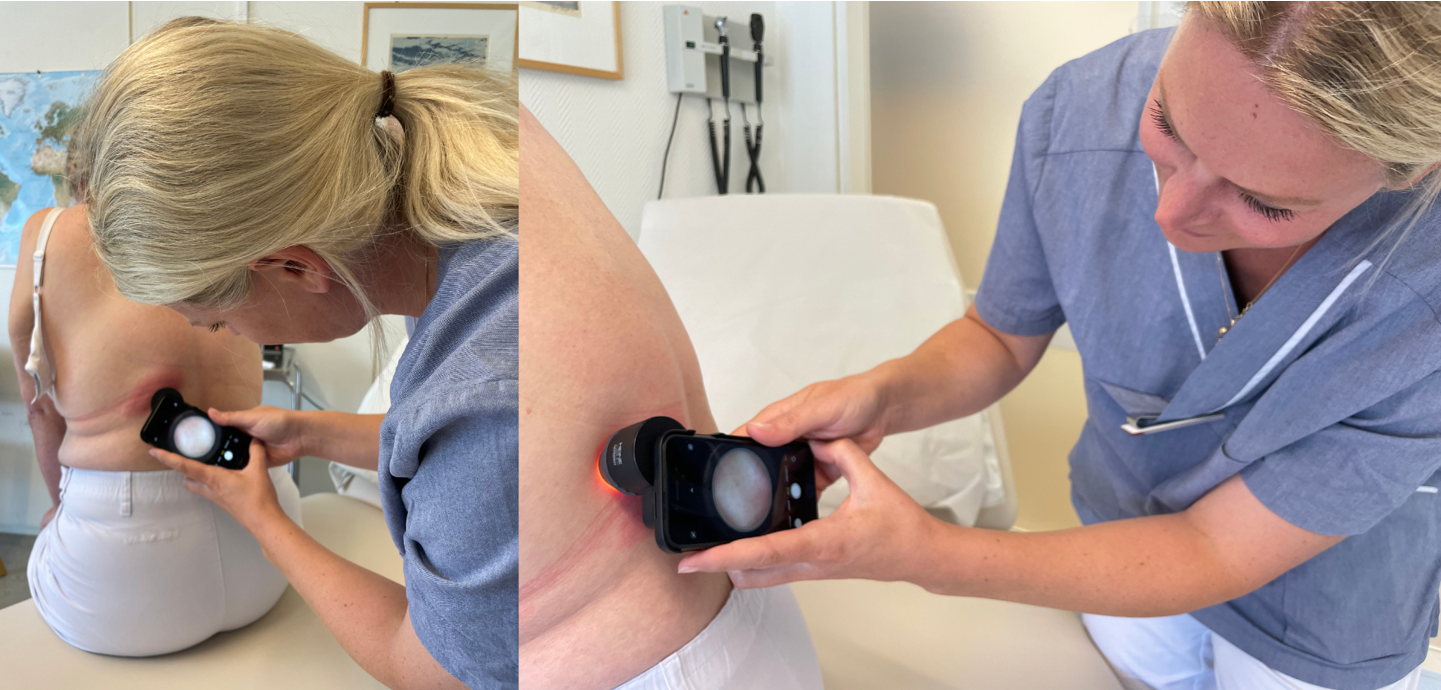
The Swedish experience in teledermatology began with a collaboration between the Department of Dermatology and Venereology at Sahlgrenska University Hospital and Närhälsan Backa Primary Health Care Center in Gothenburg, demonstrating how a pilot project can become a comprehensive regional service (Figure 1). International evidence confirms that teledermatology improves access, reduces waiting times, and proves cost-effective in rural settings when image quality and workflow integration are adequate.[1] A Brazilian study found that over half of patients could be managed with teledermatology support, reducing in-person referrals by 78%.[2] This letter examines key lessons from Sweden and their relevance for Türkiye's teledermatology expansion in rural and home care settings.
The Swedish Model: from pilot to national practice
Sweden's initial pilot used mobile phone multimedia messaging service (MMS) to transmit clinical images from primary care physicians (PCPs) to dermatologists. Two dermatologists reviewed 40 consecutive referrals, achieving correct diagnoses in 78% of cases and providing adequate management recommendations in 98% of cases. Triage decisions were appropriate in 85–95% of cases.[3] Following this success, the project grew through health technology assessments (HTA) and stakeholder engagement. It now includes over 200 primary care centers and offers quick access to specialists, often within hours for urgent cases.
Contextual differences between Swedish and Turkish healthcare systems
While the Swedish teledermatology model offers valuable lessons, direct implementation in Türkiye requires consideration of fundamental system-level differences that may affect feasibility and outcomes. In Sweden’s tax-financed healthcare system, PCPs serve as the first point of contact under a semi-formal gatekeeping model. Specialist referrals generally require authorization from a general practitioner (GP).[4] In Türkiye, patients can currently access hospital outpatient services and specialists directly, without PCP referrals.[5] While Türkiye’s healthcare system differs substantially from Sweden’s, the Swedish experience illustrates that teledermatology can be introduced successfully even in the absence of formal gatekeeping, provided that implementation follows a stepwise, region-adapted model with standardized workflows, strong primary care physicians–specialist collaboration, and low-bandwidth technical solutions. These elements are transferable and can support Türkiye in building a scalable national teledermatology framework.
Rural internet connectivity presents another critical implementation barrier. While Sweden maintains a relatively homogeneous broadband infrastructure with near-universal coverage, Türkiye exhibits substantial urban-rural digital disparities.[6,7] This heterogeneous digital landscape necessitates region-specific teledermatology solutions rather than uniform national implementation. However, adopting low-bandwidth solutions such as offline image capture, standardized compression methods, and asynchronous store-and-forward workflows, similar to Sweden’s early MMS-based model, may enable effective implementation even in rural regions with limited connectivity.
Geographic and population differences argue for tailored teledermatology. International experience shows programs targeting rural regions, homebound patients, and nursing homes reduce travel burden, maintain diagnostic accuracy, and enhance primary care competence through case-based feedback.[8-10] Positioning teledermatology as a priority for underserved populations, rather than universal entry, may pragmatically improve access while reinforcing PCPs' role.
Opportunities and Challenges for Türkiye
During the COVID-19 pandemic, 64.5% of Turkish dermatologists supported the formal establishment of teledermatology services. Yet, knowledge gaps and reimbursement concerns persist.[11] Patient-assisted teledermatology pilots showed that 81.2% of patients were willing to use teledermatology during the pandemic, but over half would not use it unless fully reimbursed. Both patients and doctors agree that approximately half of dermatological complaints can be managed remotely. However, there are some barriers, including a lack of training, insufficient technical skills, and privacy concerns.[12]
Key recommendations for implementation roadmap
- System Adaptation: Address workflow integration within the existing open-access system through stakeholder engagement.[13]
- Legal Framework: Establish clear data privacy and reimbursement guidelines.
- Infrastructure Investment: Priority should be given to improving broadband internet infrastructure in rural areas. However, this is not a requirement if you are using low-bandwidth solutions.
- Training and Guidelines: Provide comprehensive teledermatology training for primary care and dermatology physicians.[14]
- Structured Pilots should be launched in selected regions by local teledermatology champions, using clearly defined triage categories from the outset to ensure consistent workflows and reliable evaluation.
Sweden's transition from a single-clinic pilot to a region-wide teledermatology service offers a practical roadmap. Türkiye can enhance teledermatology through structured pilot programs and multidisciplinary collaboration, particularly in rural and home healthcare settings.
Ethical approval
Written informed consent was obtained from the patient for publication of the image.
Source of funding
The authors declare that the study received no funding.
Conflict of interest
The authors declare that there is no conflict of interest to disclose
Referanslar
- Coustasse A, Sarkar R, Abodunde B, Metzger BJ, Slater CM. Use of teledermatology to improve dermatological access in rural areas. Telemed J E Health. 2019;25(11):1022-1032. https://doi.org/10.1089/tmj.2018.0130
- Giavina-Bianchi M, Santos AP, Cordioli E. Teledermatology reduces dermatology referrals and improves access to specialists. EClinicalMedicine. 2020;29-30:100641. https://doi.org/10.1016/j.eclinm.2020.100641
- Börve A, Holst A, Gente-Lidholm A, Molina-Martinez R, Paoli J. Use of the mobile phone multimedia messaging service for teledermatology. J Telemed Telecare. 2012;18(5):292-296. https://doi.org/10.1258/jtt.2012.120206
- Anell A, Glenngård AH, Merkur S. Sweden health system review. Health Systems in Transition. 2012;14(5), 1-159.
- Öcek ZA, Çiçeklioğlu M, Yücel U, Özdemir R. Family medicine model in Turkey: a qualitative assessment from the perspectives of primary care workers. BMC Fam Pract. 2014;15:38. https://doi.org/10.1186/1471-2296-15-38
- Janlöv N, Blume S, Glenngård AH, Hanspers K, Anell A, Merkur S. Sweden: health system review. Health Syst Transit. 2023;25(4):1-236.
- Kara F, Uğur B. The geographical digital divide: urban-rural, regional and gender inequalities of digital transformation in Turkey. Istanbul University Journal of Geography. https://doi.org/10.26650/JGEOG2020-0023
- Gibbs J, Hanshaw S. Evaluating the effectiveness of teledermatology for undeserved populations during and post-COVID-19 [medical specialization thesis]. 2025. Available at: https://mds.marshall.edu/etd/1944
- Ahuja S, Briggs SM, Collier SM. Teledermatology in rural, underserved, and isolated environments: a review. Curr Dermatol Rep. 2022;11(4):328-335. https://doi.org/10.1007/s13671-022-00377-2
- Rubegni P, Nami N, Cevenini G, et al. Geriatric teledermatology: store-and-forward vs. face-to-face examination. J Eur Acad Dermatol Venereol. 2011;25(11):1334-1339. https://doi.org/10.1111/j.1468-3083.2011.03986.x
- Altunisik N, Turkmen D, Calikoglu E, Sener S. Views and experiences of dermatologists in Turkey about teledermatology during the COVID-19 pandemic. J Cosmet Dermatol. 2020;19(10):2460-2463. https://doi.org/10.1111/jocd.13677
- Turan Ç, Utlu Z. Investigating the factors enabling the accurate implementation of the patient-assisted teledermatology model during the pandemic in Turkey: a pilot study. Dermatol Ther. 2021;34(2):e14741. https://doi.org/10.1111/dth.14741
- Marin-Gomez FX, Vidal-Alaball J, Poch PR, Sariola CJ, Ferrer RT, Peña JM. Diagnosis of skin lesions using photographs taken with a mobile phone: an online survey of primary care physicians. J Prim Care Community Health. 2020;11:2150132720937831. https://doi.org/10.1177/2150132720937831
- McCaffrey N, Bucholc J, Ng L, et al. Protocol for a systematic review of reviews on training primary care providers in dermoscopy to detect skin cancers. BMJ Open. 2023;13(12):e079052. https://doi.org/10.1136/bmjopen-2023-079052
Telif hakkı ve lisans
Telif Hakkı © 2026 Yazar(lar). Açık erişimli bu makale, orijinal çalışmaya uygun şekilde atıfta bulunulması koşuluyla, herhangi bir ortamda veya formatta sınırsız kullanım, dağıtım ve çoğaltmaya izin veren Creative Commons Attribution License (CC BY) altında dağıtılmıştır.