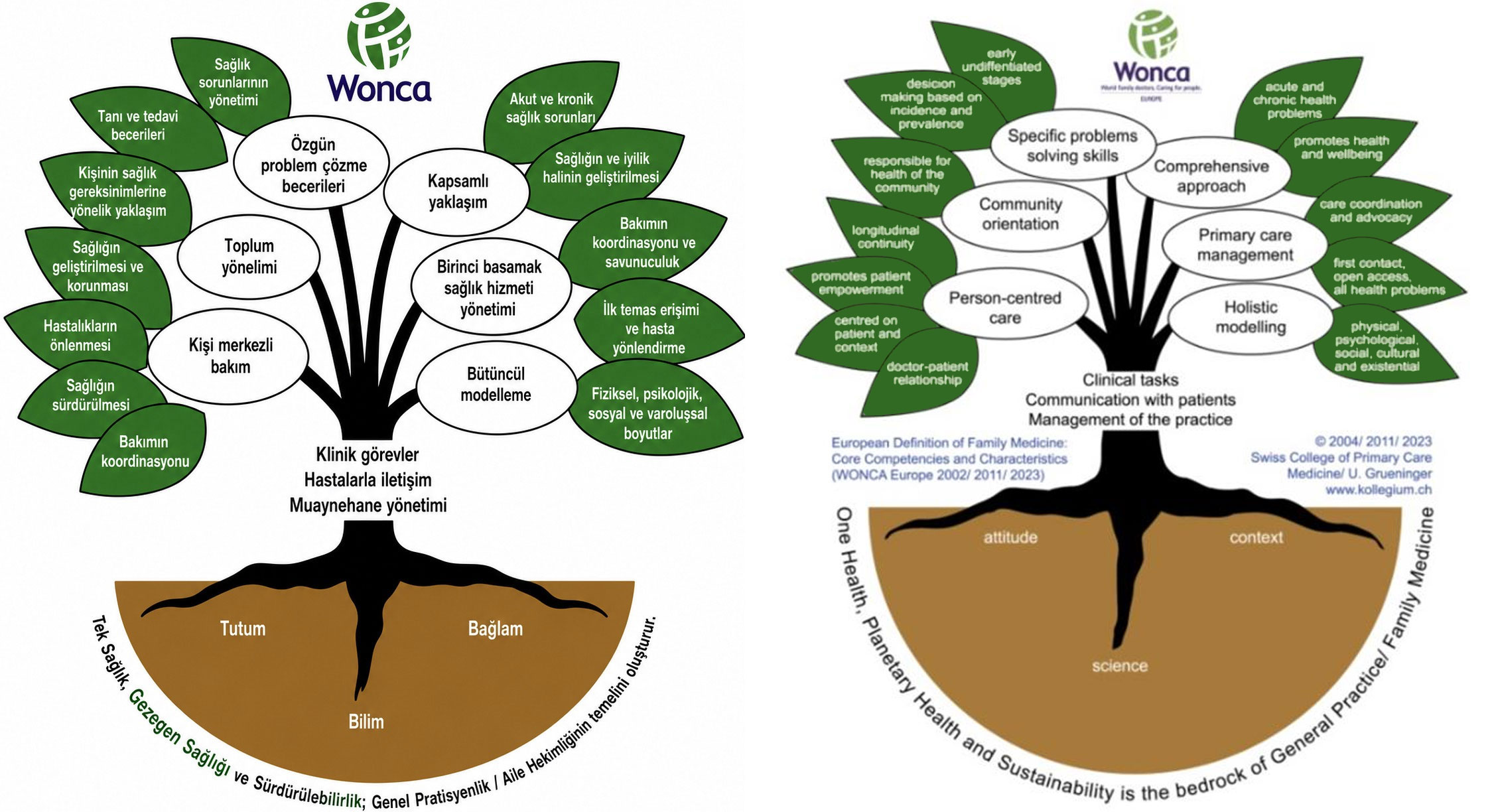
- Primary care management: This includes managing initial patient contact, addressing all health problems, coordinating care with other primary care professionals and specialists, ensuring the effective and appropriate use of healthcare resources, facilitating patients’ access to necessary services, and advocating for patients.
- Person-centered care: McWhinney describes the patient-centered approach as the physician’s effort to enter the patient’s world in order to see the illness through the patient’s perspective, while Grol emphasizes that patient-centeredness involves taking responsibility not only for the medical aspects of the problem but also for its non-medical dimensions.[1]
- The components of person-centered care include:
- assessing the patient holistically;
- exploring and interpreting both the disease and the illness experience;
- finding common ground with the patient regarding the problem and its management;
- incorporating health promotion and prevention into care;
- strengthening the doctor–patient relationship, while respecting patient autonomy;
- being realistic about time, resources, and teamwork.[2]
- Specific problem-solving skills: This involves linking decision-making processes to the prevalence and incidence of diseases in the community; being selective in the interpretation of clinical findings, history, and laboratory results; using this information collaboratively with the patient to develop an appropriate management plan; rational use of investigations; efficient time management; tolerance of uncertainty; the ability to act in emergencies; early management of undifferentiated illness; and ensuring effective and efficient use of diagnostic and therapeutic interventions.
- Comprehensive approach: This includes managing multiple complaints and acute and chronic conditions simultaneously; appropriately integrating disease prevention and health promotion strategies; improving health and well-being; and ensuring the coordination of preventive, curative, palliative, and, when necessary, rehabilitative services.
- Community orientation: This involves addressing the community's health needs while ensuring the balanced use of available resources.
- Holistic approach: This refers to applying a biopsychosocial model that considers cultural and existential dimensions.
- undergraduate and postgraduate medical education,
- training programs for family physicians in clinical practice, and
- the development of health policies.
Introduction
Dear Editor,
The WONCA Tree is a visual mnemonic that operationalizes the European Definition of General Practice/Family Medicine. This model, which incorporates the core competencies of family medicine, is among the most fundamental frameworks shaping both clinical practice and the academic structure of the discipline. The trunk symbolizes the core discipline; the main branches reflect its scope and settings; the leaves represent the defining characteristics of General Practice/Family Medicine; and the roots and soil embody the fundamental values and contextual foundations that sustain the discipline across individuals, families, communities, and society at large. For many years, it has served as a guiding framework.
The core competencies of family medicine are as follows:
With the 2023 revision, the model emphasizes three additional components: One Health, Planetary Health, and the Sustainable Development Goals (SDGs) (Figure 1). One Health is an integrated, unifying approach that aims to balance and optimize the health of humans, animals, and the environment.[3] Planetary health refers to the health of human populations and the natural systems upon which they depend, including clean air, water, and soil, as well as food and energy systems.[4] The One Health approach encompasses multisectoral collaboration, policies, legislation, and programs to improve public health.[5] These concepts highlight the necessity of evaluating human, animal, and environmental health as an interconnected whole, which justifies their placement at the model's foundational roots.
These three newly emphasized elements underline the need for a holistic, interdisciplinary, and multisectoral approach to both human and planetary health. It is suggested that One Health, Planetary Health, and the SDGs should be integrated across all six core competencies, the twelve defining characteristics, and the three additional features required for their implementation.[6] In this context, One Health and Planetary Health represent comprehensive frameworks encompassing human, animal, and environmental health.
The World Health Organization defines a “sustainable health system” as one that improves, restores, or maintains health while minimizing negative environmental impacts and maximizing opportunities for the benefit of present and future generations.[7] Planetary health, in turn, encompasses both the health of human civilization and the natural systems that support it.
Primary care has the potential to contribute positively to the sustainability of healthcare systems and to address challenges related to climate and environmental change. As highlighted in the 17 Sustainable Development Goals, ending poverty and deprivation must be pursued alongside improvements in health and education, as well as the reduction of inequalities.[8]
This approach emphasizes that human health is inseparable from environmental, animal, and ecosystem-based determinants, thereby extending family physicians' roles beyond individual patient care to include responsibilities for community and planetary health. Furthermore, the updated model enhances visibility of key priorities, such as sustainability in healthcare, reducing health inequalities, and strengthening community-based preventive approaches.
The visual metaphor, translated by TAHUD, clearly demonstrates that family medicine is not merely a set of clinical skills but a discipline grounded in social, cultural, and systemic dimensions. The integrated presentation of key concepts such as person-centered care, shared decision-making, the biopsychosocial approach, continuity, and community orientation reflects the essence of primary care.
In this context, we believe that the WONCA Tree model can make significant contributions if used as a conceptual framework in:
In conclusion, we consider that updated visual and conceptual models, such as the WONCA Tree, should be supported, as they strengthen the identity of family medicine and enhance understanding of its multidimensional nature.
Sincerely
Source of funding
The authors declare the study received no funding.
Conflict of interest
The authors declare that there is no conflict of interest to disclose.
Referanslar
- Grol R, de Maeseneer J, Whitfield M, Mokkink H. Disease-centred versus patient-centred attitudes: comparison of general practitioners in Belgium, Britain and The Netherlands. J Fam Pract. 1990;7(2):100-103. https://doi.org/10.1093/fampra/7.2.100
- Stewart M. Towards a global definition of patient centred care. BMJ. 2001;322(7284):444-445. https://doi.org/10.1136/bmj.322.7284.444
- One Health Commission. What is one health? Available at: https://www.onehealthcommission.org/en/why_one_health/what_is_one_health/ (Accessed on Mar 24, 2026).
- Whitmee S, Haines A, Beyrer C, et al. Safeguarding human health in the Anthropocene epoch: report of The Rockefeller Foundation-Lancet Commission on planetary health. Lancet. 2015;386(10007):1973-2028. https://doi.org/10.1016/S0140-6736(15)60901-1
- World Health Organization (WHO). One Health. Available at: https://www.who.int/health-topics/one-health#tab=tab_1 (Accessed on Mar 24, 2026).
- WONCA. The European definition of general practice/ family medicine. WONCA EUROPE 2023 Edition. 2023. Available at: https://www.woncaeurope.org/page/definition-of-general-practice-family-medicine (Accessed on Mar 24, 2026).
- Europe WROf. Environmentally sustainable health systems: a strategic document 2017. Available at: https://www.who.int/publications/i/item/WHO-EURO-2017-2241-41996-57723 (Accessed on Mar 24, 2026).
- WONCA. WONCA Statement on planetary health and sustainable development goals. 2017. Available at: https://www.globalfamilydoctor.com/News/PlanetaryHealthandSustainableDevelopmentGoals.aspx (Accessed on Mar 24, 2026).
Telif hakkı ve lisans
Telif Hakkı © 2026 Yazar(lar). Açık erişimli bu makale, orijinal çalışmaya uygun şekilde atıfta bulunulması koşuluyla, herhangi bir ortamda veya formatta sınırsız kullanım, dağıtım ve çoğaltmaya izin veren Creative Commons Attribution License (CC BY) altında dağıtılmıştır.