Öz
Objective: Family planning is the prevention of unintended pregnancies and the avoidance of excessive fertility. Arranging the interval between pregnancies is one of the basic requirements for a healthy pregnancy and postpartum period. The family medicine practice, implemented in Türkiye since the early 2000s, addresses this fundamental need. Our study was conducted to determine the prevalence of family planning methods, sociodemographic characteristics, and the relationship between pregnancy history and family planning method use among women aged 18-49 living in the central district of Rize.
Methods: Our descriptive cross-sectional study was conducted between 2022 and 2023 and included 413 women aged 18-49 who were registered at four Family Health Centers in the central district of Rize. Data were collected retrospectively from the Family Medicine Information System (FMIS) by the researchers involved in the study. In univariate analyses, Mann-Whitney U, Kruskal-Wallis, and Chi-square tests were used. To identify the primary factors associated with modern method use, age over 35, and the number of pregnancies were included in the analysis. Odds ratios (OR) with 95% confidence intervals (CI) were calculated.
Results: In our study, 86.9% of individuals (n = 359) used family planning methods. Among those who used a method, 57.7% (n=207) used only modern methods, 25.9% (n=93) used only traditional methods, and 16.4% (n=59) used both modern and traditional methods. When assessing the relationships among educational status, employment status, smoking, and method use, only modern method use was significantly higher than the others (p=0.001). When evaluating the relationship between gravidity and the number of pregnancies by method-use status, the mean gravidity among users of modern methods or both modern and traditional methods was significantly higher than among those using only traditional methods (p=0.049). The primary variables associated with method use were identified as being a non-smoker, not having a child younger than two years of age, having no history of abortion, and the number of pregnancies.
Conclusion: The study reveals a high rate of family planning method use in the central district of Rize province; however, adoption of modern methods remains an area requiring further development.
Anahtar Kelimeler: Family planning services, contraception, primary health care, reproductive health service
Introduction
Family planning is a fundamental public health service that enables individuals to have children at the desired time and in the desired number.[1] It plays a critical role in preventing unintended pregnancies and unsafe abortions, reducing maternal mortality, and promoting women’s reproductive rights. Increased contraceptive use has been associated with lower maternal mortality, while adequate birth spacing contributes to reductions in infant and child mortality.[2] However, approximately 40% of pregnancies worldwide remain unintended, indicating a substantial unmet need for family planning services.[1-3]
The use of contraceptive methods is influenced by multiple factors, including age, education, marital status, reproductive history, cultural norms, religious beliefs, family pressure, access to healthcare, and healthcare providers’ attitudes.[4-8] In addition to health benefits, contraception supports women’s education, employment, and long-term economic empowerment.[9] For this reason, improving access to family planning services is included among the targets of the United Nations Sustainable Development Goals for 2030.[10,11]
Globally, in 2019, 1.1 billion women aged 15–49 were estimated to need family planning; 842 million were using modern methods and 80 million traditional methods.[10] According to 2018 Turkey Demographic and Health Survey (TDHS), 70% of married women aged 15–49 use a contraceptive method, including 49% modern and 21% traditional methods, while the unmet need for family planning is 12%.[12] According to Turkish Statistical Institute (TÜİK) data, the overall fertility rate decreased from 82.7‰ in 2001 to 49.5‰ in 2024.[13] In the study conducted by Kızmaz and colleagues, 74.5% of the participants were using some method, and the most frequently used method was condoms at 38.2%.[14] Although the global use of modern methods has increased, marked regional differences persist.[10,15]
Family Health Centers (FHCs), which provide primary healthcare services in Türkiye, have an important role in family planning through counseling and method provision. Local studies are valuable for understanding contraceptive behaviors and associated factors; however, research from the Eastern Black Sea region remains limited.[16] Therefore, this study aimed to evaluate family planning method use, the distribution of modern and traditional methods, and related sociodemographic and fertility characteristics among women aged 18–49 registered at FHCs in the central district of Rize province.
Materials and Methods
This descriptive cross-sectional study was conducted between 2022 and 2023 and included 413 women aged 18-49 who were registered at four FHCs in the central district of Rize. The sample size was calculated using G*Power 3.1 software. Assuming a chi-square test with an effect size (Cohen's w) of 0.29, an alpha level of 0.05, a power of 0.99, and 3 degrees of freedom, the minimum required sample size was calculated as 280 participants.[17] The data were collected by the researchers involved in the study through retrospective file screening via the FMIS. Using FMIS, informations were obtained regarding the patient’s age, gravidity, history of abortion or stillbirth, employment status (unemployed, employed, unknown), educational status (illiterate, primary–secondary school, high school, university, unknown), smoking status (non-smoker, smoker, former smoker, unknown), place of residence (rural, urban, unknown), and whether the patient had a child younger than two years of age. For individuals whose family planning status was assessed, it was determined whether they used any family planning method, and if so, whether the method was traditional or modern. The calendar method, withdrawal, breastfeeding, and vaginal douching were classified as traditional methods. Contraceptive methods were categorized based on the World Health Organization (WHO) classification system. Within this framework, lactational amenorrhea method (LAM) is included under traditional (natural) methods unless all three eligibility criteria are strictly fulfilled (exclusive breastfeeding, amenorrhea, and infant age <6 months).[18] Modern methods were defined as intrauterine devices, condoms, tubal ligation, vasectomy, subdermal implants, oral contraceptive pills, injections, spermicides, and diaphragm use. The contraceptive methods used by participants were categorized into three groups: traditional-only, modern-only, and combined (modern + traditional). Women aged 18–49 with known method-use status were included in the study. Data entry and analysis were performed using SPSS 23.0. Descriptive data were presented as numbers, percentages, and means. The normality of the variable distributions was assessed using the Kolmogorov–Smirnov test. In the univariate analyses, family planning method-use characteristics and fertility characteristics were compared with the study variables. It was found that the continuous and discrete numerical data did not follow a normal distribution. Mann–Whitney U, Kruskal–Wallis, and chi-square tests were used in the univariate analyses. Bonferroni correction was applied in multiple comparisons to identify the group responsible for the difference. The level of significance was set at 0.05. Data classified as “unknown” were presented descriptively but excluded from inferential analyses. Independent variables identified as associated with family planning and modern method use in the univariate analyses were evaluated using logistic regression. To identify the primary factors associated with family planning method use, the model included age ≥35 years, non-smoking status, number of pregnancies, absence of abortion history, and not having a child younger than two years of age. The number of pregnancies was entered into the logistic regression model as a continuous count variable. Odds ratios (OR) with 95% confidence intervals were calculated. Ethical approval for the study was granted by the Clinical Research Ethics Committee of the Recep Tayyip Erdoğan University School of Medicine.
Results
A total of 86.9% of the participants (n = 359) were using a family planning method. Among those who used a method, 57.7% used only modern methods, 25.9% used only traditional methods, and 16.4% used both modern and traditional methods (Figure 1).
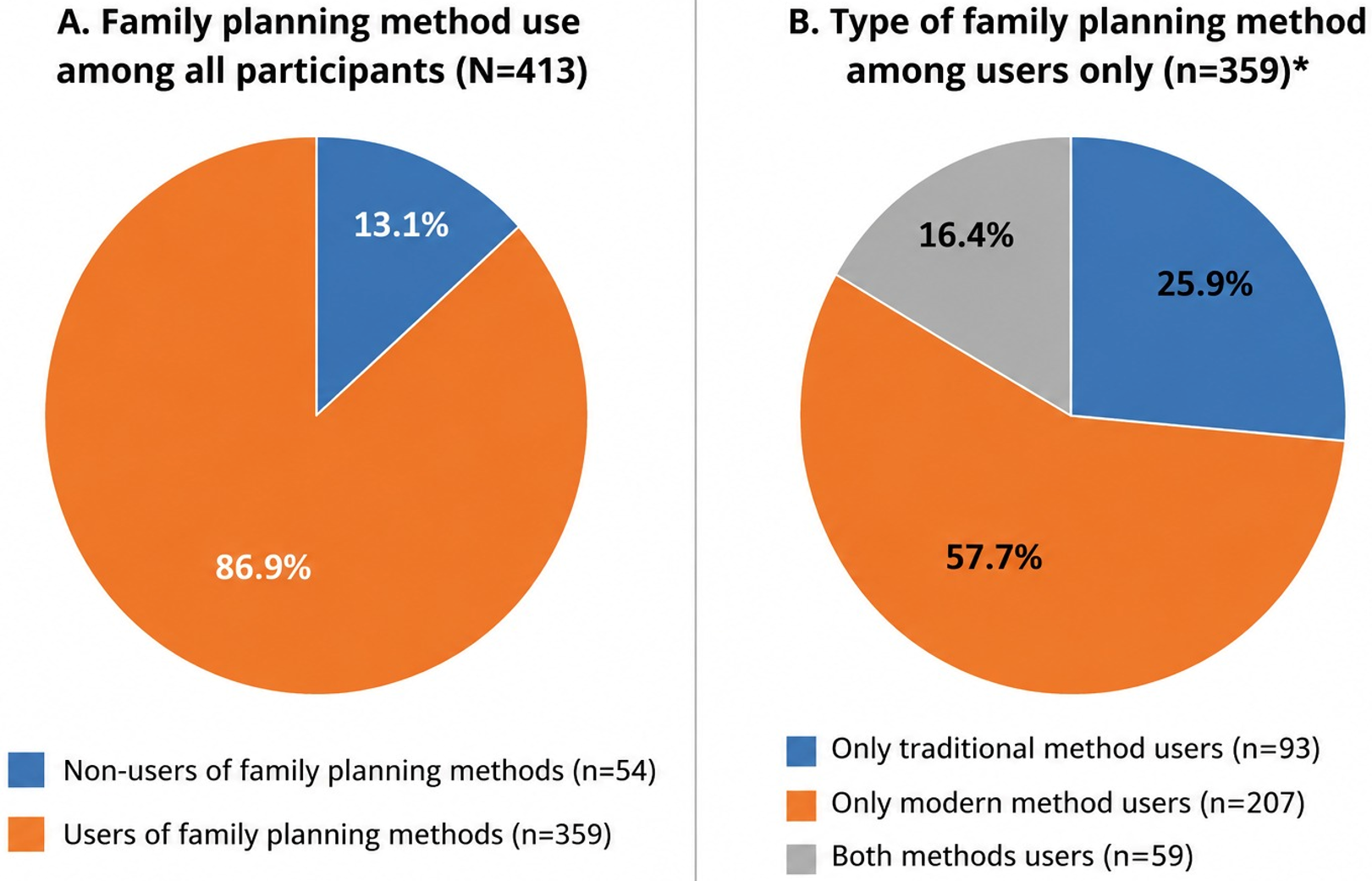
Among traditional methods, withdrawal was the most commonly used, preferred by 25.6% of participants (n = 92). The breastfeeding method was reported by 0.3% (n = 1), and the calendar method was not used by any participant (n = 0). Among modern methods, the most widely used was the condom, reported by 37.9% of participants (n = 136). This was followed by intrauterine devices (IUDs) at 7.8% (n = 28), tubal ligation at 5.0% (n = 18), oral contraceptives (OCPs) at 3.9% (n = 14), and injections at 2.2% (n = 8). Vasectomy, subdermal implants, and combined condom + OCP use were each reported by 0.3% of participants (n = 1). Spermicide and diaphragm methods were not used by any participant (n = 0). Among the combined use of modern and traditional methods, the most common combination was condom + withdrawal, reported by 16.1% of participants (n = 58). In addition, only one participant (0.3%, n = 1) reported using the combination of condom + injection + withdrawal. Participants’ method-use rates were not associated with age group, educational level, place of residence, employment status, or smoking status. No statistically significant association was observed between gravidity level and contraceptive method use (p = 0.127). When contraceptive use was assessed according to fertility characteristics, an increase in the frequency of method use was observed with the rising number of pregnancies. The prevalence of contraceptive use among women with zero pregnancies (66.7%) was significantly lower than among those with one or more pregnancies (p = 0.001). Among participants with a history of abortion, the contraceptive use rate was 77.4%, compared to 88.6% among those without; this difference was found to be statistically significant (p = 0.016). No significant association was identified between a history of stillbirth and contraceptive use (p = 0.793). Contraceptive use was 81.6% among participants with a child under the age of two and 88.7% among those without; however, this difference was not statistically significant (p = 0.062) (Table 1).
|
a Bonferroni correction: indicates the group contributing to the difference. *Chi-square. |
|||||
| Table 1. Relationship between contraceptive use status and demographic characteristics. | |||||
| Method users n (%) | Non-users n (%) | Total n (%) | p value* | ||
| Age group (years) |
15-24 25-34 35 and above |
24 (80.0) 187 (84.6) 148 (91.4) |
6 (20.0) 34 (15.4) 14 (8.6) |
30 (7.3) 221 (53.5) 162 (39.2) |
p=0.078 |
| Educational status |
Illiterate High school Unknown |
4 (100.0) 85 (87.6) 104 (87.4) 52 (86.7) 114 (85.7) |
0 (0.0) 12 (12.4) 15 (12.6) 8 (13.3) 19 (14.3) |
4 (1.0) 97 (23.5) 119 (28.8) 60 (14.5) 133 (32.2) |
p=0.933 |
| Employment status |
Employed Unemployed Unknown |
69 (88.5) 137 (85.6) 153 (87.4) |
9 (11.5) 23 (14.4) 22 (12.6) |
78 (18.9) 160 (38.7) 175 (42.4) |
p=0.803 |
| Smoking status |
Nonsmoker-Quit Smoker |
292 (89.0) 43 (79.6) |
36 (11.0) 11 (20.4) |
328 (79.4) 54 (13.1) |
p=0.051 |
| Residence |
Rural Urban |
29 (85.3) 330 (87.1) |
5 (14.7) 49 (12.9) |
34 (8.2) 379 (91.8) |
p=0.768 |
| Gravidity |
0 1 2 3 4 and above |
20 (76.9) 110 (82.7) 130 (90.9) 57 (87.7) 42 (91.3) |
6 (23.1) 23 (17.3) 13 (9.1) 8 (12.3) 4 (8.7) |
26 (6.3) 133 (32.2) 143 (34.6) 65 (15.7) 46 (11.1) |
p=0.127 |
| Number of pregnancies |
0a 2 3 4 and above |
24 (66.7) 121 (84.0) 133 (90.5) 56 (93.3) 25 (96.2) |
12 (33.3) 23 (16.0) 14 (9.5) 4 (6.7) 1 (3.8) |
36 (8.7) 144 (34.9) 147 (35.6) 60 (14.6) 26 (6.3) |
p=0.001 |
| History of abortion |
Yes No |
48 (77.4) 311 (88.6) |
14 (22.6) 40 (11.4) |
62 (15.0) 351 (85.0) |
p=0.016 |
| History of stillbirth |
Yes No |
5 (83.3) 354 (87.0) |
1 (16.7) 53 (13.0) |
6 (1.5) 407 (98.5) |
p=0.793 |
| Children under 2 years |
Yes No |
84 (81.6) 275 (88.7) |
19 (18.4) 35 (11.3) |
103 (24.9) 310 (75.1) |
p=0.062 |
| Total | 359 (86.9) | 54 (13.1) | 413 (100.0) | ||
When the relationship between the category of contraceptive method used and individuals’ educational status, employment status, and smoking habits were examined, the combined use of modern and traditional methods was found to be significantly more common among smokers. (p=0.001). The relationship between mean gravidity, number of pregnancies, and the category of contraceptive method was found to be statistically significant (p = 0.033 and p = 0.043, respectively). The observed differences were primarily attributable to the frequency of women with a gravidity of 3 and those with 3 pregnancies in the “both modern and traditional methods” category, which differed from the expected frequencies (Table 2).
|
a,b Bonferroni correction: indicates the group contributing to the difference. *Chi-square. |
||||||
| Table 2. Relationship between method group and demographic characteristics. | ||||||
| Demographic characteristics | Modern methods only n (%) | Traditional methods only n (%) | Both modern and traditional methods n (%) | Total n (%) |
p value* | |
| Age group (years) | 15-24 | 16 (66.7) | 5 (20.8) | 3 (12.5) | 24 (6.7) | p=0.457 |
| 25-34 | 108 (57.8) | 53 (28.3) | 26 (13.9) | 187 (52.1) | ||
| 35 and above | 83 (56.1) | 35 (23.6) | 30 (20.3) | 148 (41.2) | ||
| Educational status | Illiterate | 3 (75.0) | 0 (0.0) | 1 (25.0) | 4 (1.1) | p=0.327 |
| Primary-Middle school | 52 (61.2) | 26 (30.6) | 7 (8.2) | 85 (23.7) | ||
| High school | 63 (60.6) | 29 (27.9) | 12 (11.5) | 104 (29.0) | ||
| University | 33 (63.5) | 18 (34.6) | 1 (1.9) | 52 (14.5) | ||
| Employment status | Employed | 48 (69.6) | 18 (26.1) | 3 (4.3) | 69 (19.2) | p=0.367 |
| Unemployed | 82 (59.9) | 45 (32.8) | 10 (7.3) | 137 (38.2) | ||
| Smoking | Non-smoker/Quit | 175 (59.9) | 83 (28.4) | 34 (11.6) | 292 (81.3) | p=0.001 |
| Smoker | 18 (41.9) | 8 (18.6) | 17a (39.5) | 43 (12.0) | ||
| Residence | Rural | 13 (44.8) | 9 (31.0) | 7 (24.1) | 29 (8.1) | p=0.307 |
| Urban | 194 (58.8) | 84 (25.5) | 52 (15.8) | 330 (91.9) | ||
| Gravidity | 0 | 11 (55.0) | 9 (45.0) | 0a (0.0) | 20 (5.6) | p=0.033 |
| 1 | 61 (55.5) | 31 (28.2) | 18 (16.4) | 110 (30.6) | ||
| 2 | 72 (55.4) | 37 (28.5) | 21 (16.2) | 130 (36.2) | ||
| 3 | 36 (63.2) | 6 (10.5) | 15b (26.3) | 57 (15.9) | ||
| 4 and above | 27 (64.3) | 10 (23.8) | 5 (11.9) | 42 (11.7) | ||
| Number of pregnancies | 0 | 14 (58.3) | 10 (41.7) | 0a (0.0) | 24 (6.7) | p=0.043 |
| 1 | 69 (57.0) | 33 (27.3) | 19 (15.7) | 121 (33.7) | ||
| 2 | 72 (54.1) | 36 (27.1) | 25 (18.8) | 133 (37.0) | ||
| 3 | 34 (60.7) | 8 (14.3) | 14b (25.0) | 56 (15.6) | ||
| 4 and above | 18 (72.0) | 6 (24.0) | 1 (4.0) | 25 (7.0) | ||
| History of abortion | Yes | 32 (66.7) | 8 (16.7) | 8 (16.7) | 48 (13.4) | p=0.272 |
| No | 175 (56.3) | 85 (27.3) | 51 (16.4) | 311 (86.6) | ||
| History of stillbirth | Yes | 2 (40.0) | 2 (40.0) | 1 (20.0) | 5 (1.4) | p=0.704 |
| No | 205 (57.9) | 91 (25.7) | 58 (16.4) | 354 (98.6) | ||
| Children under 2 years | Yes | 50 (59.5) | 22 (26.2) | 12 (14.3) | 84 (23.4) | p=0.828 |
| No | 157 (57.1) | 71 (25.8) | 47 (17.1) | 275 (76.6) | ||
| Total | 207 (57.7) | 93 (25.9) | 59 (16.4) | 359 (100.0) | ||
When method use was evaluated according to modern and traditional subcategories, condom use was identified as the most frequently utilized method, with a prevalence of 37.9%. When mean gravidity of the participants and number of pregnancies were examined in relation to method use, participants who used a contraceptive method had significantly higher mean gravidity and number of pregnancies (p=0.026 and p=0.001, respectively). As expected, increasing age was also associated with a significant rise in mean gravidity and number of pregnancies (p=0.001). Educational and employment statuses were also evaluated. Illiterate individuals had higher mean gravidity and parity, while employed individuals had lower mean gravidity and parity (p=0.001) (Table 3). Method use was 2.3 times higher among non-smokers compared with smokers (p=0.040; 95% CI: 1.04–5.11), 2.0 times higher among those without a child under two years of age (p=0.046; 95% CI: 1.01–3.95), and 3.9 times higher among those without a history of abortion (p=0.001; 95% CI: 1.72–8.85). Additionally, each one-unit increase in the number of pregnancies was associated with a 2.2-fold increase in method use (p=0.001; 95% CI: 1.49–3.24) (Table 4).
| * Mann Whitney U, **Kruskal-Wallis. | ||||||
| Table 3. The relationship between participants’ gravidity, contraceptive method use, and sociodemographic characteristics. | ||||||
| Characteristics | n | Gravidity mean±sd (median) |
p value | Number of pregnancies mean±sd (median) |
p value | |
| Family planning use | Using | 359 | 2.1±1.3 (2.0) | p=0.026* | 1.8±1.1 (2.0) | p=0.001* |
| Not using | 54 | 1.6±1.1 (1.0) | 1.2±1.0 (1.0) | |||
| The methods Used | Modern | 207 | 2.1±1.4 (2.0) | p=0.049** | 1.9±1.1 (2.0) | p=0.094** |
| Traditional | 93 | 1.8±1.3 (2.0) | 1.7±1.0 (2.0) | |||
| Modern+Traditional | 59 | 2.2±1.1 (2.0) | 1.9±0.8 (2.0) | |||
| Age group | 15-24 | 30 | 1.3±1.0 (1.0) | p=0.001** | 1.1±0.8 (1.0) | p=0.001** |
| 25-34 | 221 | 1.6±1.0 (1.0) | 1.5±0.8 (1.0) | |||
| 35 and above | 162 | 2.7±1.5 (2.0) | 2.3±1.2 (2.0) | |||
| Educational status | Illiterate | 4 | 4.5±3.9 (3.5) | p=0.001** | 3.3±2.6 (2.5) | p=0.001** |
| Primary-middle school | 97 | 2.6±1.4 (2.0) | 2.3±1.2 (2.0) | |||
| High school | 119 | 2.0±1.2 (2.0) | 1.8±0.9 (2.0) | |||
| University | 60 | 1.6±1.1 (1.0) | 1.4±0.9 (1.0) | |||
| Employment status | Employed | 78 | 1.8±1.1 (2.0) | p=0.001** | 1.7±1.1 (2.0) | p=0.013** |
| Unemployed | 160 | 2.3±1.4 (2.0) | 2.0±1.1 (2.0) | |||
| Smoking | Non-smoker/Quit | 328 | 2.0±1.3 (2.0) | p=0.345** | 1.8±1.1 (2.0) | p=0.510** |
| Smoker | 54 | 2.1±1.2 (2.0) | 1.8±1.0 (2.0) | |||
| Residence | Rural | 34 | 2.2±1.3 (2.0) | p=0.396* | 1.8±1.2 (2.0) | p=0.907* |
| Urban | 379 | 2.0±1.3 (2.0) | 1.8±1.1 (2.0) | |||
| History of abortion | Yes | 62 | 3.6±1.5 (3.0) | p=0.001* | 2.4±1.3 (2.0) | p=0.001* |
| No | 351 | 1.7±1.0 (2.0) | 1.7±1.0 (2.0) | |||
| History of stillbirth | Yes | 6 | 3.5±2.2 (3.0) | p=0.043* | 2.5±1.0 (2.5) | p=0.078* |
| No | 407 | 2.0±1.3 (2.0) | 1.8±1.1 (2.0) | |||
| Children under 2 years | Yes | 103 | 1.8±1.0 (2.0) | p=0.089* | 1.7±0.8 (1.0) | p=0.217* |
| No | 310 | 2.1±1.4 (2.0) | 1.8±1.2 (2.0) | |||
| Total | 413 | 2.0 (1.0-3.0) | 2.0 (1.0-2.0) | |||
|
SE: Standard error; OR: Odds ratio; CI: Confidence interval. *Continuous count variable. |
||||||
| Table 4. Independent variables primarily associated with contraceptive method use (logistic regression). | ||||||
| B | SE | Wald | p | OR | OR (95% CI) | |
| Not smoking | 0.83 | 0.41 | 4.20 | 0.040 | 2.30 | 1.04-5.11 |
| Having no child under two years of age | 0.69 | 0.33 | 3.97 | 0.046 | 2.00 | 1.01-3.95 |
| No history of abortion | 1.34 | 0.39 | 11.61 | 0.001 | 3.90 | 1.72-8.85 |
| Number of pregnancies* | 0.79 | 0.19 | 15.94 | 0.001 | 2.20 | 1.49-3.24 |
| Age over 35 years | 0.24 | 0.40 | 0.35 | 0.552 | 1.27 | 0.58-2.78 |
Discussion
In this study, the prevalence of family planning method use among women aged 18–49 in the central district of Rize province was 86.9%, a rate higher than the national average in Türkiye (70%) and exceeding that reported in several previous regional studies.[12,19-21] This finding indicates that primary healthcare services play an effective role in family planning and that Family Health Center (FHC)–based service delivery yields positive outcomes at the regional level.
When method types were examined, the prevalence of modern methods was 57.7%, indicating that modern methods were more widely used compared to traditional methods.
When interpreted in the context of national evidence, the contraceptive prevalence observed in this study is slightly higher than the national average reported in the 2018 Türkiye Demographic and Health Survey (TDHS), which indicated that 70% of currently married women use any contraceptive method, with modern method use at approximately 49% [TDHS 2018].[12] In comparison, the modern method use in the present study (57.7%) suggests a relatively more advanced transition toward modern contraceptive uptake in this region. This may be attributable to the fact that the study population consisted of women receiving services in a centrally located healthcare facility. It may also reflect discrepancies between registry-based data and the participants’ current contraceptive status.
Data from Türkiye and worldwide similarly demonstrate an increasing preference for modern methods.[10,15] The most commonly used modern method was the condom (37.9%), while the most frequently used traditional method was withdrawal (25.6%). Previous national studies have reported a similar distribution, which may be explained by the condom’s easy accessibility, low cost, and user-friendliness.[19-21] The widespread use of the withdrawal method may be attributed to cultural habits, its simplicity, and its free cost. However, considering the high failure rates associated with traditional methods, this pattern is known to pose risks to reproductive health.[2,22]
In our study, method utilization rates did not show a significant association with age, education level, employment status, or place of residence. However, it is noteworthy that the use of modern methods was higher among non-smokers. In the literature, it has been reported that healthy lifestyle behaviors tend to cluster together and that contraceptive attitudes may be more favorable among individuals who do not smoke.[23] This finding indicates that factors influencing the preference for modern methods are not only demographic but also behavioral. In the logistic regression analysis, the number of pregnancies was the strongest predictor of method use. Studies reporting that the need for family planning becomes more pronounced with increasing parity support this finding.[20,24] It is expected that individuals approaching the completion of their childbearing, or who do not desire further childbearing, tend to prefer more effective and permanent methods. The finding that individuals with a history of abortion had significantly lower method use rates is an important result. In the literature, it has been reported that in the post-abortion period, factors such as lack of information, insufficient counseling, a desire for a new pregnancy within a short interval, or difficulties in accessing modern methods may contribute to this situation.[5,22] This finding indicates the need to strengthen post-abortion family planning counseling. The lower rate of method use among individuals with a child under the age of two may be related to reliance on the contraceptive effect of breastfeeding during the postpartum period, perceptions of infertility, or delays in accessing healthcare facilities. Similar findings have also been reported in studies on postpartum family planning.[22] Overall, our study shows that the use of modern methods remains below the desired level, and that method preference is more closely associated with reproductive history and behavioral factors than with sociodemographic characteristics. In the literature, the multilevel factors influencing family planning preferences include levels of knowledge, cultural norms, partner influence, religious beliefs, healthcare providers' attitudes, and service delivery models.[4-8,25-27] Therefore, family planning services need to be strengthened to focus not only on method provision but also on counseling, behavior change, and service access.
Limitations
Because our study was retrospective, it was not possible to assess participants’ knowledge of the methods, the reasons for non-use, the determinants of their preferences, or the role of the spouse/partner in method choice. Women’s satisfaction with the method and whether they switched methods could not be investigated. Some variables could not be evaluated for all participants due to missing data in the system. Furthermore, the data obtained using this method do not provide information about unmet family planning needs.
Conclusion
This study shows that the rate of family planning method use in the central district of Rize province is high; however, the use of modern methods remains an area that requires further improvement. Both overall contraceptive use and preference for modern methods increased markedly with increasing numbers of pregnancies. This finding indicates that reproductive history should be carefully considered in family planning counselling. The lower method use among women with a history of abortion suggests that this group may not be adequately benefiting from family planning services and highlights the need to strengthen counseling services during the postpartum and post-abortion periods. To increase the use of modern methods, it is important to address knowledge gaps, improve access to these methods, and strengthen healthcare providers' counseling roles. Enhancing the accessibility and quality of family planning services is critically important for maintaining a healthy reproductive life cycle and strengthening women’s health. The development of sustainable policies at national and regional levels, along with the expansion of knowledge, attitude, and behavior-based counseling services, will support progress in this field.
Ethical approval
This study has been approved by the Clinical Research Ethics Committee of the Recep Tayyip Erdoğan University School of Medicine (approval date 13.06.2024, number 2024/133). Written informed consent was obtained from the participants.
Source of funding
The authors declare the study received no funding.
Conflict of interest
The authors declare that there is no conflict of interest to disclose.
Referanslar
- United Nations Department of Economic and Social Affairs, Population Division. World family planning 2022: meeting the changing needs for family planning: contraceptive use by age and method. New York: United Nations; 2022. Available at: https://www.un.org/development/desa/pd/sites/www.un.org.development.desa.pd/files/files/documents/2023/Feb/undesa_pd_2022_world-family-planning.pdf
- Cleland J, Conde-Agudelo A, Peterson H, Ross J, Tsui A. Contraception and health. Lancet. 2012;380(9837):149-156. https://doi.org/10.1016/S0140-6736(12)60609-6
- United Nations Population Fund (UNFPA). State of world population 2022: seeing the unseen: the case for action in the neglected crisis of unintended pregnancy. New York: UNFPA; 2022. Available at: https://www.unfpa.org/sites/default/files/pub-pdf/EN_SWP22%20report_0.pdf
- Geist C, Aiken AR, Sanders JN, et al. Beyond intent: exploring the association of contraceptive choice with questions about Pregnancy Attitudes, Timing and How important is pregnancy prevention (PATH) questions. Contraception. 2019;99(1):22-26. https://doi.org/10.1016/j.contraception.2018.08.014
- Ross J, Hardee K, Rosenberg R, Zosa-Feranil I. Inequities in family planning in low- and middle-income countries. Glob Health Sci Pract. 2023;11(3):e2300070. https://doi.org/10.9745/GHSP-D-23-00070
- Pinter B, Hakim M, Seidman DS, Kubba A, Kishen M, Di Carlo C. Religion and family planning. Eur J Contracept Reprod Health Care. 2016;21(6):486-495. https://doi.org/10.1080/13625187.2016.1237631
- Okwori G, Smith MG, Beatty K, Khoury A, Ventura L, Hale N. Geographic differences in contraception provision and utilization among federally funded family planning clinics in South Carolina and Alabama. J Rural Health. 2022;38(3):639-649. https://doi.org/10.1111/jrh.12612
- D'Souza P, Bailey JV, Stephenson J, Oliver S. Factors influencing contraception choice and use globally: a synthesis of systematic reviews. Eur J Contracept Reprod Health Care. 2022;27(5):364-372. https://doi.org/10.1080/13625187.2022.2096215
- Finlay JE, Gulaid M, Mibenge C, et al. Contraception to women's economic empowerment: a narrative review. World Dev. 2025;196:107167. https://doi.org/10.1016/j.worlddev.2025.107167
- United Nations, Department of Economic and Social Affairs, Population Division. World family planning 2020 highlights: accelerating action to ensure universal access to family planning. New York: United Nations; 2020. Available at: https://www.un.org/development/desa/pd/sites/www.un.org.development.desa.pd/files/files/documents/2020/Sep/unpd_2020_worldfamilyplanning_highlights.pdf (Accessed on Jul 10, 2026).
- United Nations. Transforming our world: the 2030 agenda for sustainable development. New York: United Nations; 2015. Available at: https://sdgs.un.org/publications/transforming-our-world-2030-agenda-sustainable-development-17981 (Accessed on Jul 10, 2026).
- Hacettepe Üniversitesi Nüfus Etütleri Enstitüsü. 2018 Türkiye nüfus ve sağlık araştırması. Ankara: Hacettepe Üniversitesi Nüfus Etütleri Enstitüsü, T.C. Cumhurbaşkanlığı Strateji ve Bütçe Başkanlığı, TÜBİTAK; 2019. Available at: https://fs.hacettepe.edu.tr/hips/dosyalar/Ara%C5%9Ft%C4%B1rmalar%20-%20raporlar/2018%20TNSA/TNSA2018_ana_Rapor_compressed.pdf (Accessed on Jul 10, 2026).
- Türkiye İstatistik Kurumu (TÜİK). Türkiye'de istatistiklerle kadın. TÜİK; 2025. Available at: https://www.tuik.gov.tr/media/announcements/ist_kadin2025.pdf (Accessed on Jul 10, 2026).
- Kızmaz M, Ay ME, Döner E, Gökgöz Durmaz F, Kumtepe Kurt B. Evaluation of using family planning methods and affecting factors in married women aged 18-49. Smyrna Tıp Dergisi. 2022;1;44-51.
- Kavanaugh ML, Pliskin E. Use of contraception among reproductive-aged women in the United States, 2014 and 2016. F S Rep. 2020;1(2):83-93. https://doi.org/10.1016/j.xfre.2020.06.006
- Gökdemir Ö, Pak H, Aygün O, et al. The use of contraceptive method patterns: evaluation at family health centers. İstanbul Tıp Fakültesi Dergisi. 2021;84(4):574-581. https://doi.org/10.26650/IUITFD.2021.908828
- Çalıkoğlu EO, Bilge Yerli E, Kavuncuoğlu D, Yılmaz S, Koşan Z, Aras A. Use of family planning methods and influencing factors among women in Erzurum. Med Sci Monit. 2018;24:5027-5034. https://doi.org/10.12659/MSM.908388
- World Health Organization (WHO). Family planning: a global handbook for providers. 4th ed. Baltimore and Geneva: CCP and WHO; 2022.
- Çelik N, Babaoğlu ÜT. Sosyodemografik değişkenler ile aile planlaması bilgi, yöntem kullanım durumları: aile planlaması araştırması. Turkish Journal of Family Medicine and Primary Care. 2024;18(1):41-47. https://doi.org/10.21763/tjfmpc.1377545
- Uzunçakmak T, Hepokur ŞN. Evli kadınların aile planlaması yöntemlerini tercihlerinin ve tutumlarının belirlenmesi. Sürekli Tıp Eğitimi Dergisi. 2024;32(5):334-343. https://doi.org/10.17942/sted.1067387
- Bilgin Şahin B, Oruç Özdemir İ, Ceylan C, et al. Family planning method use and unmet need for family planning in a selected semi-urban region in Manisa. Sağlık ve Toplum. 2025;35(2):44-53.
- Makins A, Cameron S. Post pregnancy contraception. Best Pract Res Clin Obstet Gynaecol. 2020;66:41-54. https://doi.org/10.1016/j.bpobgyn.2020.01.004
- Pelit Aksu S, Alkaş S. Attitudes of women and men towards contraceptive methods and affecting factors. Ordu Üniversitesi Hemşirelik Çalışmaları Dergisi. 2025;8(1):77-87. https://doi.org/10.38108/ouhcd.1401583
- Coleman-Minahan K, Boniface ER, Fuentes-Rivera E, Saavedra-Avendaño B, Riosmena F, Darney BG. Patterns in contraceptive use among women of Mexican origin in the united states and in Mexico. Obstet Gynecol. 2022;140(5):784-792. https://doi.org/10.1097/AOG.0000000000004921
- Mukanga B, Nkonde H, Daka V. Exploring the multilevel factors influencing women's choices and utilisation of family planning services in Mufulira district, Zambia: a socio-ecological perspective. Cogent Public Health. 2023;10(1):2168589. https://doi.org/10.1080/27707571.2023.2168589
- Kubahoniyesu T, Mugabo H. Predictors of family planning choices in Rwanda: insights from the 2019-2020 demographic and health survey. Open Access J Contracept. 2025;16:71-80. https://doi.org/10.2147/OAJC.S527717
- Rathore I, Logeswari BM, Prasath N. A study on contraceptive choices and usage trends among reproductive age individuals in urban and rural areas. Cureus. 2025;17(6):e86721. https://doi.org/10.7759/cureus.86721
Telif hakkı ve lisans
Telif Hakkı © 2026 Yazar(lar). Açık erişimli bu makale, orijinal çalışmaya uygun şekilde atıfta bulunulması koşuluyla, herhangi bir ortamda veya formatta sınırsız kullanım, dağıtım ve çoğaltmaya izin veren Creative Commons Attribution License (CC BY) altında dağıtılmıştır.